
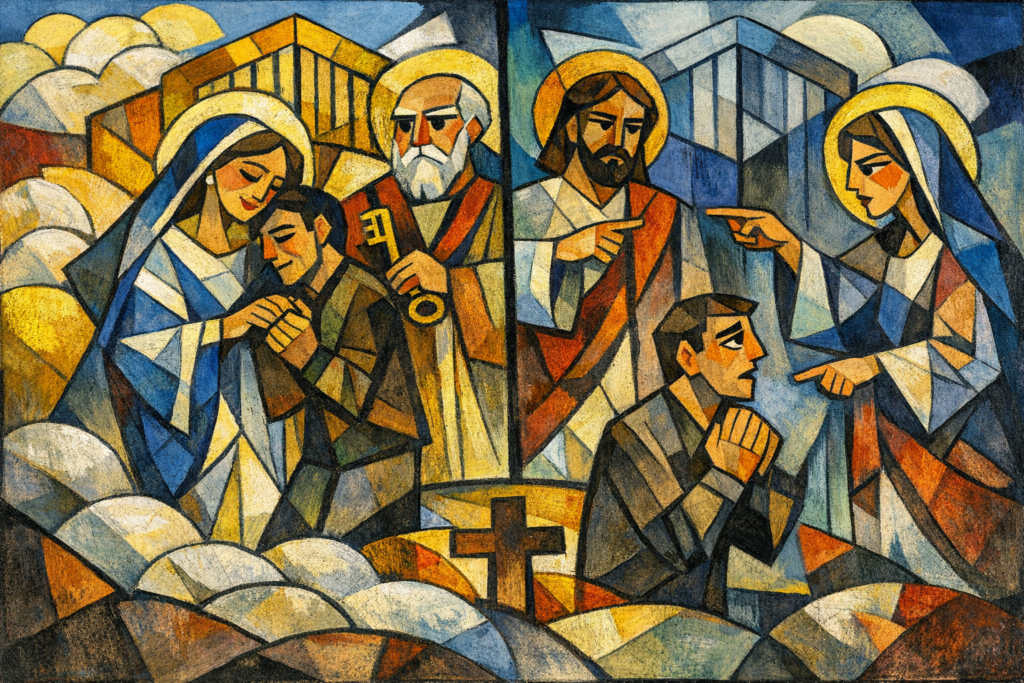
If you are a Catholic reading this, let me invite you into the following scenario.
Scenario 1: We both die and are greeted at the pearly gates of Heaven. We see a woman standing next to our Lord. She approaches me first, hugs me, and lightly smacks my wrist, saying lovingly, “Life would have been a lot easier if you had just prayed to me to intercede for you.”
Scenario 2: She approaches you instead and says, “Why on earth would you waste your time praying to me? My Son would like a few words with you.”
In both scenarios, we can take some comfort in knowing that we believed in Jesus, despite our many flaws. It is not our righteousness that saves us, but His alone. However, this post will explain why Scenario 2 is more likely to happen on the day of the resurrection.
Historical Timeline of Praying to Saints
For roughly the first two hundred years after the resurrection of Christ, no explicit historical texts show Christians directing prayers to departed saints or to Mary.
Discussions of the role of departed believers began to only appear in the mid‑3rd century. In his Commentary on the Epistle to the Romans (written in the 240s), Origen cautiously speculates that saints who have died and are with Christ might in some way act on our behalf “after the manner of the angels, who perform services for our salvation,” but he immediately adds that this belongs among “the secret things of God” and should not be fully committed to writing.
My Catholic friends often tell me that they are not praying to Mary, but rather, asking her to intercede for them. They don’t worship her and rather reserve divine honor for God alone. While I understand this perspective and the sincerity behind it, I’m not convinced the early Church fathers they often appeal to would have held their same views. Just as we shouldn’t pick and choose portions of Scripture to support our position, I believe we should also be careful not to selectively appeal to parts of Church history that fit our present narrative.
Note: The highlighted texts are marked this way for two reasons:
- To show that attributes and qualities that belong to God are being given to a human being.
- To show how questionable they are and how they conflict with the Bible, the actual Word of God.
The Sub Tuum Praesidium: Earliest Surviving Marian Invocation
The earliest known Marian invocation preserved in Christian tradition is the prayer Sub Tuum Praesidium. It appears on a Greek papyrus discovered in Egypt and is commonly dated to the mid-3rd century (around AD 250), though some scholars suggest a later date in the 4th century (approximately AD 250–350). In translation, it reads:
Under your protection we seek refuge, Holy Mother of God.
Do not despise our petitions in our necessities,
but always deliver us from all dangers,
for you are holy.
This prayer provides the earliest clear documentary evidence of Christians directly addressing Mary in petition.
This is not a good practice that gradually went bad; it is a bad practice that has become worse. And that which has developed in a direction increasingly far away from the earliest Christian faith. Even if praying to Mary started from some kind of sincere piety, the expressions grew progressively stronger in ways that don’t seem consistent with the beliefs and practices of the earliest Church and the teachings of Christ.
Exploring Additional Prayers from the Catholic Church’s Catechism
CCC 2679: “Mary is the perfect Orans (pray-er), a figure of the Church. When we pray to her, we are adhering with her to the plan of the Father, who sends his Son to save all men. Like the beloved disciple we welcome Jesus’ mother into our homes, for she has become the mother of all the living. We can pray with and to her. The prayer of the Church is sustained by the prayer of Mary and united with it in hope.”
CCC 2682: “Because of Mary’s singular cooperation with the action of the Holy Spirit, the Church loves to pray in communion with the Virgin Mary, to magnify with her the great things the Lord has done for her, and to entrust supplications and praises to her.”
CCC 969: “This motherhood of Mary in the order of grace continues uninterruptedly from the consent which she loyally gave at the Annunciation and which she sustained without wavering beneath the cross, until the eternal fulfilment of all the elect. Taken up to heaven she did not lay aside this saving office but by her manifold intercession continues to bring us the gifts of eternal salvation…. Therefore the Blessed Virgin is invoked in the Church under the titles of Advocate, Helper, Benefactress, and Mediatrix.‘”
CCC 2677: “Holy Mary, Mother of God: With Elizabeth we marvel, ‘And why is this granted me, that the mother of my Lord should come to me?’ Because she gives us Jesus, her son, Mary is Mother of God and our mother; we can entrust all our cares and petitions to her: she prays for us as she prayed for herself: ‘Let it be to me according to your word.’ By entrusting ourselves to her prayer, we abandon ourselves to the will of God together with her: ‘Thy will be done.'”
Our Mother of Perpetual Help Prayer: Behold, O Mother of Perpetual Help, at thy feet a wretched sinner, who has recourse to thee and confides himself entirely to thee. Thou knowest, O Mary, how often I have fallen and how many times I have offended God. Help me, O loving Mother, to avoid sin in the future, and obtain for me the grace to lead a holy life. In thy hands I place my eternal salvation; to thee I entrust my soul. Count me among thy most faithful servants. Take me under thy protection; that is enough for me. Yes, for if thou protectest me, I shall fear nothing: not my sins, because thou wilt obtain for me their pardon and remission; not the evil spirits, for thou art more powerful than all the powers of hell; not even Jesus, my Judge, because by one prayer from thee He will be appeased. Come to my aid for I commend myself to thee. Amen.
Essentially, these are some of the prayers that should raise some eyebrows. There are more prayers I haven’t touched that are far more outrageous. If you are curious, I suggest you watch this video HERE.
However, the prayers I have put forward are some of the more popular ones. I’m not suggesting that all prayers to Mary are like this. However, many of them attribute Jesus’ divine qualities to her, and the theme of seeking forgiveness through her is quite common.
It’s important to recognize, though, that there is no further propitiation for sins. Christ’s sacrifice is sufficient. Through the Holy Spirit and the merits of Jesus Christ, we can approach God directly. Again, there might be a kind of formal acknowledgment of this in practice with modern Catholics, but this is not a “both-and” situation when it comes to Mary.
The Catholic Church Can Get Things Wrong!
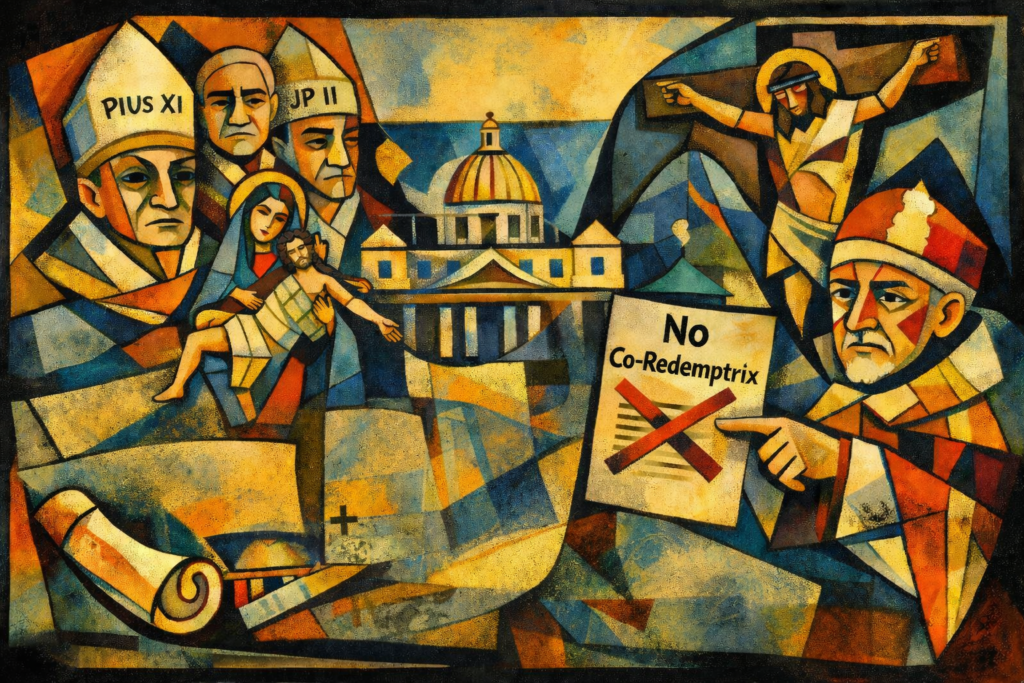
Over the centuries, Catholic theologians and several popes have used the title “Co‑redemptrix” for Mary to describe her unique cooperation with Christ in the work of our redemption. Pope Pius X allowed the term to appear in certain official prayers and even attached indulgences to prayers that invoked Mary as the “Co‑redemptrix of the human race,” especially in decrees from 1908, 1913, and 1914.
Pope Pius XI went further by explicitly calling Mary “Co‑redemptrix” in addresses in 1933 and 1935, highlighting that she shared in Christ’s sufferings at Calvary in a dependent and secondary way. Later popes, such as Pius XII and John Paul II, strongly emphasized Mary’s cooperation in our salvation, and John Paul II used the word “Co‑redemptrix” in several non‑dogmatic talks and messages.
However, in November 2025, the Vatican’s Dicastery for the Doctrine of the Faith released a doctrinal note titled Mater Populi fidelis, approved by Pope Leo XIV. This document explicitly discourages the use of “Co‑redemptrix” and similar titles in official teaching and catechesis, arguing that such language can blur Christ’s unique role as the sole Mediator and Redeemer.
My comment? Well, I think this backtracking speaks for itself. Better late than never. Just a couple more doctrines to go. 🙂
My Final Thoughts:
The Hail Mary is not addressed to God but to Mary. It directs prayer to someone other than God for intercession, even though Scripture is clear about whom we are to approach as our mediator and intercessor in prayer.
We are called to pray for people on earth because there is a living, two-way relationship in which we can speak and hear, encourage, correct, and comfort one another. By contrast, Mary and the saints, though alive in God’s presence in a spiritual sense, are still in the state of the dead in the biblical sense: they await the resurrection and do not yet have their glorified bodies, which Scripture teaches will be given at the second coming of Christ.
Catholics often appeal to Revelation 5:8 to support the idea of the saints in Heaven presenting our prayers. However, I appeal to the importance of also recognizing context even more. In the New Testament, the term “saints” refers to believers, as seen for example in Romans 1:7, where Paul addresses ordinary Christians as “saints.” Revelation 5:8 portrays a heavenly worship scene just moments before the judgments of the apocalypse begin on earth. The “prayers of the saints” there are best understood as the prayers of believers (God’s people) rising before Him as a pleasing offering. It does not narrate any request from believers to the elders, nor any explicit implication for Christians to pray to departed believers.
Throughout Scripture, God’s faithful servants have always directed their prayers to God alone. Moses never prayed to anyone but God. Daniel did not pray to anyone else. Neither Paul nor any of the apostles teach or model prayer to departed believers. When Jesus teaches about prayer, He specifically instructs us to pray to the Father, not to any other figure. There is no command, example, or encouragement in the New Testament to pray to those who have died.
The God of the Old Testament consistently reveals Himself as a jealous God who does not share His glory with another and does not tolerate rivals in worship or devotion. If God was so righteously jealous for His exclusive place in the hearts and prayers of His people then, there is no reason to think His character has changed now.
I don’t believe Catholics are deliberately doing something wrong. Some of the best Christians I know are Catholics. But it’s more like the life of Solomon: he does something inherently wrong at first, but it doesn’t seem so terrible in the beginning. It simply grows worse over time. And that’s what is happening here.
Lastly, if this has pricked your conscience, even a little, ask yourself why you need anyone’s intercession except His alone.
Repent and believe the true Word of God; it’s never too late. I will also share some verses from the Bible down below to encourage you.
Jesus Loves You.
Verses Supporting Prayer to God Alone
Additional Supporting Passages
- Luke 11:27-28 — Jesus redirecting someone praising Mary
- Romans 8:26-27 — The Holy Spirit intercedes for us
- Hebrews 11:39-40 — The Saints awaiting resurrection
- Hebrews 4:16 — What we should be doing with ours prayers
- 1 Thessalonians 4:13-18 — Believers Who Have Died