
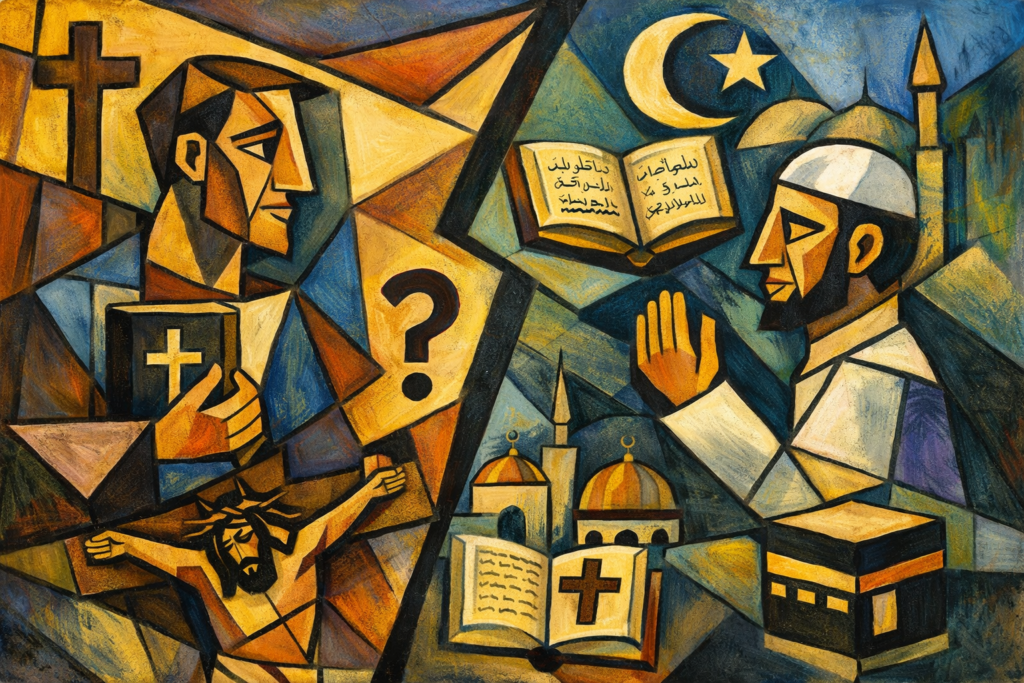
I want to start off by saying that this is not written to offend anyone. Many of my closest friends are Muslim. Some of the kindest, most sincere believers I know pray five times a day and take Allah seriously in a way that challenges even me as a Christian.
So this is not a debate post or an attack on Islam. Rather, it is a collection of my findings over the years on one simple question: “What is the truth?”, and an honest look at what the Qur’an and the Bible say.
The Islamic Dilemma
The Qur’an repeatedly teaches that Allah revealed the Torah (Tawrat) and the Gospel (Injil), and that these books contained “guidance and light”:
- Allah “sent down the Book in truth, confirming what came before it,” and “revealed the Torah and the Gospel” as guidance for mankind (Surah Ali ‘Imran – 3-4).
- Jesus, son of Mary, was given the Gospel “in which was guidance and light,” confirming the Torah (Surah Al-Ma’idah – 46).
- “Let the People of the Gospel (Christians) judge by what Allah has revealed therein” (Surah Al-Ma’idah – 47).
- About Jews and Christians (“People of the Book”), the Qur’an says: “Our God and your God is One; and to Him we submit” (Surah Al-‘Ankabut – 46).
The Qur’an also strongly insists that Allah’s words cannot be changed:
- “None can change His words” (Surah Al-An’am – 115).
Taking all this at face value, these points follow:
- The Torah and the Gospel were revelations from Allah.
- They were still meaningful and authoritative in Prophet Muhammad’s time.
- Allah’s words cannot be altered.
If you are intellectually honest, you have to accept that these are the Qur’an’s own claims up to this point. But this is where the dilemma also begins.
Later Muslim Claims of Biblical Corruption (Tahrif)
Early Muslim interaction with the Bible was often relatively positive; early sources show Muslims quoting biblical texts as useful and, at least in part, reliable. The idea that the entire biblical text was corrupted (tahrif al‑nass, textual corruption) developed more fully later, especially with the 11th‑century scholar Ibn Ḥazm, who argued that the Bible must have been altered because it conflicted with the Qur’an.
If the Torah and the Gospel were true,
then the Qur’an contradicts key teachings within them — especially the Crucifixion and the identity of Jesus Christ, who in the New Testament presents Himself as the Son of God.
If the Torah and Gospel were false,
as scholars like Ibn Ḥazm argued, then the Qur’an’s affirmation of those previous scriptures and its command that Jews and Christians should judge by them would become problematic. And if they were truly altered, how could Allah’s words be corrupted at all?
This is sometimes known as the “Islamic dilemma”.
What is the Truth?
Christians and Muslims interestingly agree on many things: that there is one God, that He created the world, that revelation and prophets matter, that there will be a day of judgment, and more. But there are two central historical questions where they sharply disagree:
- Did Jesus claim to be the Son of God?
- Did He die and rise from the dead?
The Qur’an presents Jesus (ʿĪsā) as a great prophet, born of the virgin Mary, doing miracles by God’s permission, but emphatically not God Himself and not the Son of God in the Christian sense (for example, Q 4:171; 5:72–75).
The Qur’an’s Account
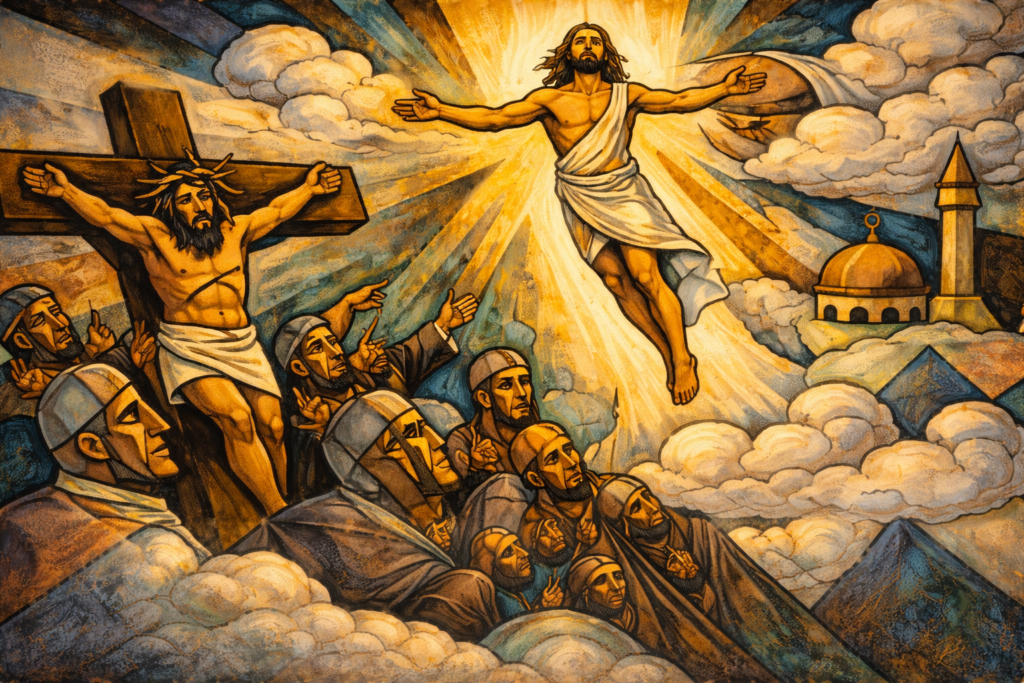
Regarding the crucifixion, the Qur’an states:
“They did not kill him, nor did they crucify him, but [another] was made to resemble him to them… Rather, Allah raised him to Himself.” (Surah An-Nisa – 157-158)
Classical Muslim commentators often taught that someone else was made to look like Jesus and was crucified in his place. Whatever the exact interpretation, the core claim is clear: Jesus was not actually killed by crucifixion.
The New Testament’s Account
By contrast, the New Testament’s central claim is that Jesus truly died by crucifixion and rose from the dead.
Here is a basic historical timeline:
- Jesus’ crucifixion is usually dated around 30–33 CE.
- Prophet Muhammad lived around 570–632 CE in Arabia, and the Qur’an was proclaimed in that 7th‑century context.
By Prophet Muhammad’s time:
- Christian communities in multiple regions and languages (Greek, Latin, Syriac, Coptic) had been teaching Jesus’ death and resurrection for centuries.
- New Testament manuscripts were already in wide circulation, and the text we have today matches those early manuscripts very closely, as textual critics have observed through thousands of manuscripts and fragments.
- Non-Christian sources from the first and second centuries also mention Jesus’ death. Tacitus (Roman historian), Josephus (Jewish historian), and Lucian of Samosata (2nd-century satirist) all refer to Jesus being crucified. They were not Christians and had no reason to defend Christian beliefs, yet they agree he was executed by Roman authorities.
From a Christian standpoint, this raises a question: on what basis should a 7th‑century text (The Qur’an) that contradicts first‑century eyewitness testimony and multiple independent historical sources be treated as the more accurate account?
The Qur’an and Islam constantly appeals back to previous divine revelations to make sense of itself, but also says that those same previous revelations have been corrupted in their text whenever they disagree with the Qur’an. In a sense, it cuts off the very branch it is sitting on: affirming earlier scriptures and Allah’s unchangeable words on the one hand, but dismissing their central claims on the other.
Some More Claims the Qur’an Makes
I won’t go into a full case for Jesus’ divinity, but He did more than make a claim. He asserted that He was the Son of God, performed signs and healings, fulfilled prophecies, predicted His death and resurrection, and Christians testify that He rose on the third day and appeared to many witnesses over a period of 40 days, a message His followers were willing to suffer and die for.
But as a text, the Qur’an runs into other obstacles besides the dilemma. There are several claims Prophet Muhammed made that are based on history, archaeology and science that should raise some questions.
Creation: Was it six or eight days?
The Qur’an repeatedly says creation took six days (7:54; 10:3; 11:7; 25:59). But Surah Fussilat 41:9–12 says that it took two days for the earth, four days for provisions, and two days for the heavens, which adds up to a total of eight days. Which contradicts the above verses.
The “Samaritans” in Moses’ time
In the Golden Calf story, “al-Sāmirī” misleads Israel (20:85–88). However, the “al-Sāmirī”, who were the Samaritan community, only emerged centuries after Moses. The community doesn’t even exist during the time of the Exodus.
Crucifixion before its historical use
The Qur’an uses the same word for crucifixion in the stories of Joseph, Moses, and Jesus (12:41;7:124; 4:157). Yet crucifixion as an execution method only comes centuries later around the Persian and Roman periods, long after the traditional dates of Joseph and Moses.
Embryology descriptions
Passages (23:12–14; 22:5; 96:2) describe embryonic development in stages: semen→ clinging clot → chewed-like lump → bones → bones clothed with flesh. This sequence is not unique to the Qur’an, in fact, it closely resembles earlier embryological ideas found in the work of the Greek physician Galen, who wrote in the 2nd century CE, around four centuries before the Qur’anic revelations. However, modern embryology shows that bones and skeletal muscles develop together from common embryonic tissues, so this ancient model is also scientifically inaccurate.
There are many other places where the Qur’an seems to conflict with established history and earlier Scripture. If we are being intellectually honest, those tensions shouldn’t just be brushed aside but they should make us pause and ask why certain important details differ.
The Reality of the Truth
Did Jesus really die on the cross?
If Jesus did die by crucifixion, then the heart of Christianity stands, and the Qur’an’s denial of that event is a mistake.
If Jesus did not die on the cross, then the New Testament is fundamentally wrong, and Christianity collapses.
The Bible was written over roughly 1,500 years by many authors, yet it presents a coherent storyline that culminates in Jesus Christ. It is also regularly used by historians and archaeologists as a guide to real places, rulers, and events, with numerous external confirmations when read in context.
On the crucifixion specifically, most scholars, including non-Christians, accept it as a historical fact because it meets multiple historical criterias.
But even if you ignore these, just look at the lives of his disciples. They had lived, travelled, eaten, and slept beside Jesus for three years. After the crucifixion they all reported speaking with Him, touching Him, and sharing meals with Him repeatedly over a period of forty days. It is implausible that a group so familiar with Him could collectively misidentify a stranger standing before them day after day.
They were convinced they had encountered the risen Jesus, and they held to that claim despite persecution and death.
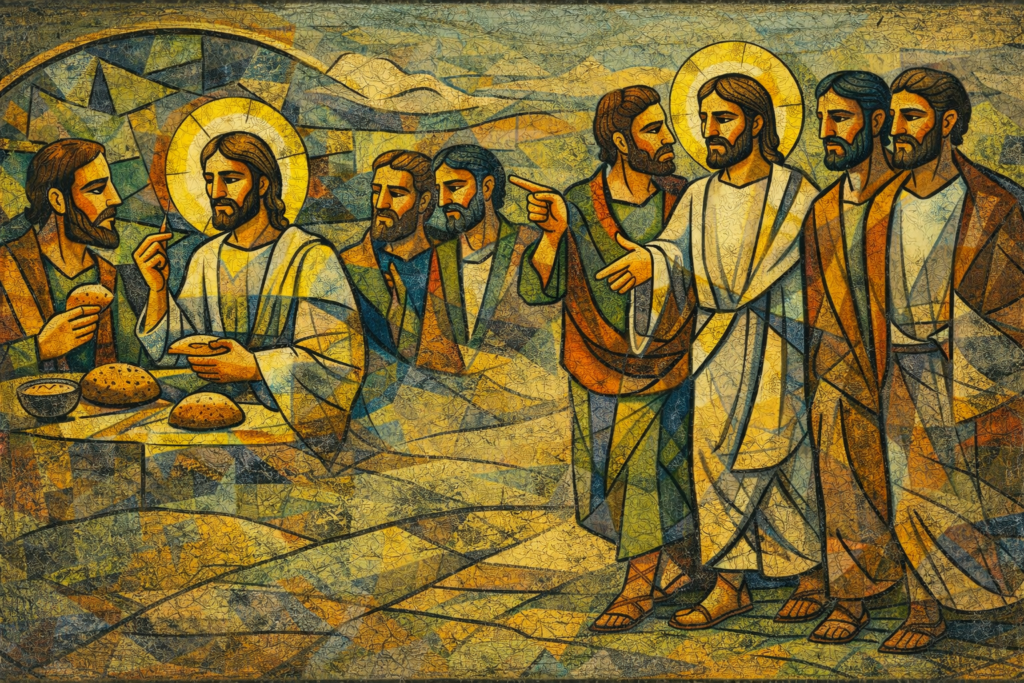
People may die for something false they believe is true, but they do not willingly suffer and die for something they know they fabricated.
From a Christian perspective, the one event that saves them is described as a “deception” in a book written about six hundred years after the New Testament period.
When I place the claims side by side and examine the historical evidence, the Gospel remains convincing.
None of this removes love or respect for Muslims. The call here is simply to pursue God seriously, wherever that search leads. Until then, remember, Jesus loves you.